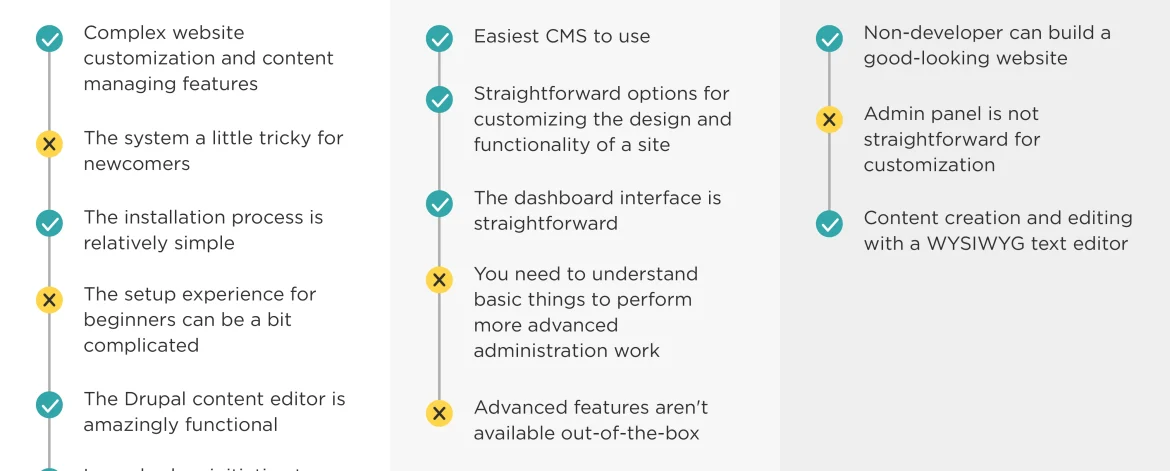

Although WordPress has the lion’s share of the content management system (CMS) market, it’s not the only viable product you can use to create your website. One popular alternative is Joomla, which presently powers approximately 6.6% of global websites (just over 2 million), such as Holiday Inn Express and the U.K. National Crime Agency.
While Joomla doesn’t offer as many themes or plug-ins as WordPress, Joomla users find the platform much more robust than WordPress. While it’s true that Joomla isn’t as user-friendly on the surface, there are many reasons to use the platform that are worth taking the extra time to learn it.
![Why Joomla Is Better than WordPress in [CurrentYear]](https://dt2sdf0db8zob.cloudfront.net/wp-content/uploads/2018/11/image2-38.png)
You’ll Enjoy Greater Content Flexibility
One knock against WordPress is that you’re locked into a single theme when designing your website. You get the same basic layout regardless of which webpage you visit. You don’t get the same limitation with Joomla, as you’re allowed to use multiple templates on your website. Want a different template for your blogs than for your primary webpage? No problem!
Also, if you need to display different forms of content on your website, Joomla gives you greater flexibility, with modules that allow you to mix up the content types on each webpage. WordPress themes and plug-ins sometimes have difficulty handling multiple content types, or they may restrict how you display certain content on your webpage. By contrast, Joomla gives you exceptional design freedom
Joomla Has Better Backend Organization
One reason some people like WordPress is that you can easily create content and add webpages to your website, but one knock against the platform is that it lacks proper organization. Sometimes it’s difficult to figure out how to make an article appear on specific webpages or to make plug-ins work on one specific area of the website. If you want to add something as simple as a menu, it takes extra coding or plug-ins to make it work properly.
With Joomla, the backend is much more organized, and your available options are much more straightforward than WordPress. If you want to restrict articles to certain webpages, you can do so easily. Want to add a new menu to your webpage? The option is simple and doesn’t require a bunch of extra coding. For users who want excellent organization, Joomla is a clear winner.
You Can Make Your Website Multilingual from the Start
WordPress allows you to make your website and content multilingual, but the catch is that you have to install plug-ins for your website. This requires regular updates of your language plug-ins and even replacements if a plug-in quits working with a future update.
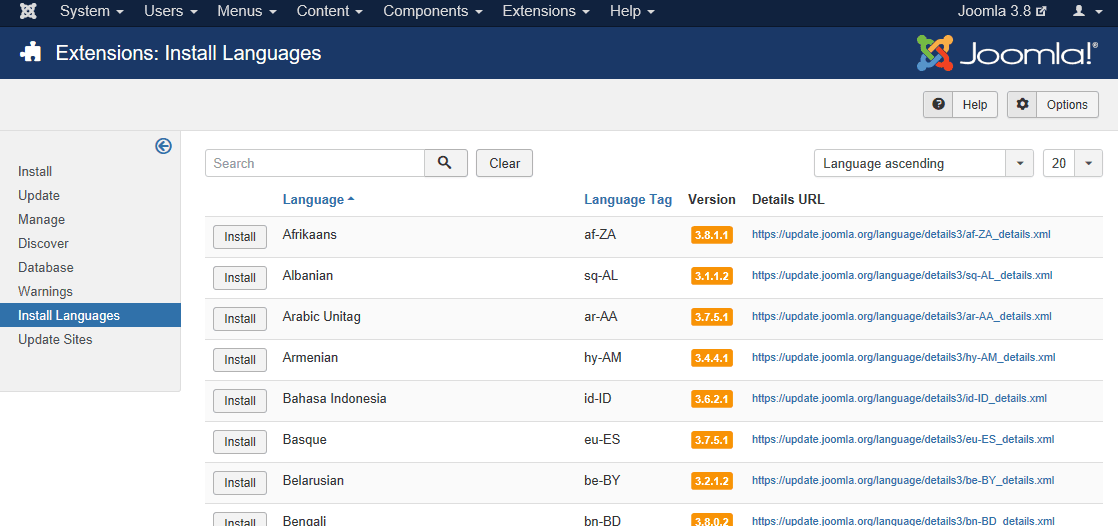
With Joomla, multilingual functionality comes standard with the platform. To make your website multilingual, head over to the language manager and select the languages you wish to translate your content into. If you need a language that doesn’t come with the backend, all you need to do is install that language module; you don’t need to install a new plug-in, as you might with WordPress.
Joomla Provides More Configurable Options
A running theme you’ve probably noticed with WordPress is that you need plug-ins and extensions to unlock functionality. This includes even simple things such as basic SEO. Joomla gives you many more options you can configure on the backend without having to install additional plug-ins.
Head over to the global configurations webpage, and you’ll find options for everything: from articles and banners, to menus, media, redirects, and more. You can also modify SEO settings from the backend without having to install a program such as Yoast. Instead of having settings for just a few components for your website, you have settings for all components.
Granted, all these extra options will require a bit more work from the user, so beginners will have a bit of a learning curve. However, the extra time needed to learn the platform is worth it due to increased functionality.
Your Website Will Have Stronger Default Security
If you want to ensure the strongest security on WordPress, you need to install additional plug-ins. Big shock, huh? Also, if you want to use HTTPS, SSL, or two-factor authentication for your website, you have to make code modifications or add plug-ins to your website.
That’s not the case with Joomla, which comes with options to enable 2FA and to force SSL connections for your website. This ensures that those connecting to your website enjoy the safest experience possible.
Joomla also provides a wide variety of security extensions, similar to WordPress, so both platforms can be made extremely secure. The difference is that you’ll do a lot less legwork in securing your Joomla website than you would with WordPress.
Looking to improve your website security? Check out this article about protecting your website with Sucuri.
Simpler Doesn’t Always Mean Better
The main reason that WordPress has its massive market share is that it’s tailored toward beginners and bloggers. So if you’re a rank beginner, or if you’re looking to make a simple website such as a blog, then WordPress may be your best choice. Feel free to learn more about the platform in our WordPress expert review . There’s no reason to reinvent the wheel if a platform fits your needs.
However, WordPress has its limitations. You have to add plug-ins to unlock the majority of features on WordPress, and if the platform is upgraded, there’s a good chance that some of your add-ons will stop functioning correctly. This doesn’t happen as often with Joomla, as many basic features come built into the platform. And if there’s an issue with an extension, Joomla’s developers work quickly to fix problems to prevent hacks and other problems.
Next, WordPress is not as capable of handling complex websites. It can manage many personal and small-business websites, but more complex e-commerce websites sometimes run into issues, especially those handling massive amounts of data. Often, you’ll find that WordPress websites bog down with more advanced setups — something Joomla is better suited to handle.
Joomla is a better solution for larger and enterprise-grade websites. That’s why websites such as IKEA and Linux.com use Joomla. It provides a well-organized backend with the scalability necessary to handle large website projects.
Where do you envision your website in a few years? If you see it as a simple website with only minimal feature changes, then going to Joomla may be unnecessary. However, if you have big plans for your website and see either massive growth or the need to handle more complex data and content, then Joomla is going to be the better option.
- Jun 03, 2016
 0
0- by Brad Litwin
There are a number of reasons that open-source software systems are good for businesses. Joomla, a free open-source content management system, is one of the most popular. By February of 2014, it had been downloaded more than 50 million times. Statistics show that it is now the second most used system on the Internet. Full customization, there are more than 7,700 extensions, both free and commercial, available in their extension directory. Version 3.5, released earlier this month, offers 34 new features in addition to other popular features such as a search function, page caching, RSS feeds, news flashes, blogs, and language internationalization support.

American multi-national corporation eBay was founded in 1995 by Pierre Omidyar, who was himself a computer programmer. Headquartered in San Jose, California, the company now has operations in over 30 countries worldwide. On September 21, 1998, eBay went public with the target share price of $18 being far surpassed on the first day of trading, when shares sold for $53.50. By 2008, the company had more than 15,000 employees. In 2015, it reported net revenue of $2.1 billion dollars. It seems fitting that a company begun by a computer programmer uses Joomla as its content management software.

In 2012, General Electric was listed in Forbes as the fourth-largest company in the world. The GE brand name itself was valued at $28.8 billion dollars. Their slogan “Imagination at work”, may be one of the reasons that the company has appeared for 21 years on the Fortune 500 list, ranking at number eight this year. To promote innovation, GE ran a two year campaign to tell the stories of innovators who were “reshaping the world through act or invention”. Joomla provides all the necessary tools for companies to fully utilize their imaginations when creating interactive websites and content for their customers.
The world’s largest furniture seller since 2008, IKEA uses Joomla to reach customers in 381 stores in 47 countries. In 2010, the company reported $23.1 billion dollars in sales. In October of 2012, those sales rose an additional 3.1 percent to $37.9 billion dollars due to growth in Russia, China, and the U.S. In 2004, Ikea was named by Working Mothers magazine as one of the 100 Best Companies for Working Mothers. The company was ranked at number 80 of Fortune’s 200 Best Companies to Work For in 2008.

Holiday Inn, based in Atlanta, Georgia, is one of the world’s largest hotel chains. The first Holiday Inn opened in August 1952 in Memphis, Tennessee. The 1000th hotel was opened in San Antonio, Texas in 1968. Today, with 3,463 hotels around the worldD, it is estimated more than 100 million guests stay in one their 435,299 bedrooms each night. The first to offer a centralized reservation system called Holidex in 1965, the company recently converted their main corporate site to Joomla. Using a customized multi-site manager, they are now able to run all of their individual sites from a single installation.

Harvard University, established in 1636, has the largest university endowment in the world, which was valued at $32 billion dollars in 2011. The Harvard University Library System includes approximately 80 individual libraries with more than 18 million volumes, making it the largest academic library in the U.S. and one of the largest in the world. With 16,000 staff and faculty, it is one of the world’s most prestigious universities, and was ranked at the top for academic performance in 2014. In 2011, Harvard was ranked at number one in the world in terms of how many alumni hold CEO positions in Fortune Global 500 companies.
Additional features that make Joomla the choice for so many successful businesses include a greater number of themes to choose from and the ability to upgrade the core from the back end. Upgrading has been made as simple as logging in, going to the update tab, and clicking “install update”. Joomla free open-source software presents a serious challenge to the old business adage that you get what you pay for. In this case, all users, whether an established tech-savvy business or a new blogger building their first website, are getting much much more.
